Most beginners can learn the basics of SEO in about 6 to 8 weeks of steady study, and start doing real, useful work on a website within 2 to 3 months. Getting good enough to rank competitive keywords on your own, or to confidently handle a client's site, usually takes 6 months to a year of actual practice on real websites — not just watching videos. There is no fixed finish line in SEO, because search engines keep changing, but there is a clear point where you know enough to be useful, and that point is closer than most people assume.
Why there is no single answer
SEO is really three things stacked together: technical understanding (how a website is built and how search engines read it), content strategy (what to write and why), and a feel for data (reading Google Search Console and analytics without panicking at the numbers). Most courses and tutorials only teach the first two. The third one, the judgement to know whether a drop in traffic is a real problem or just normal fluctuation, only comes from watching real websites over weeks and months.
This is why two people can both say they "learned SEO" and mean very different things. One can write a keyword-optimised blog post. The other can audit a 200-page e-commerce site, fix its technical issues, and explain to a client why rankings take time. Both are valid stages. The question is which one you are aiming for.
A realistic timeline
Here is a rough breakdown, assuming you study with some structure rather than randomly watching YouTube videos:
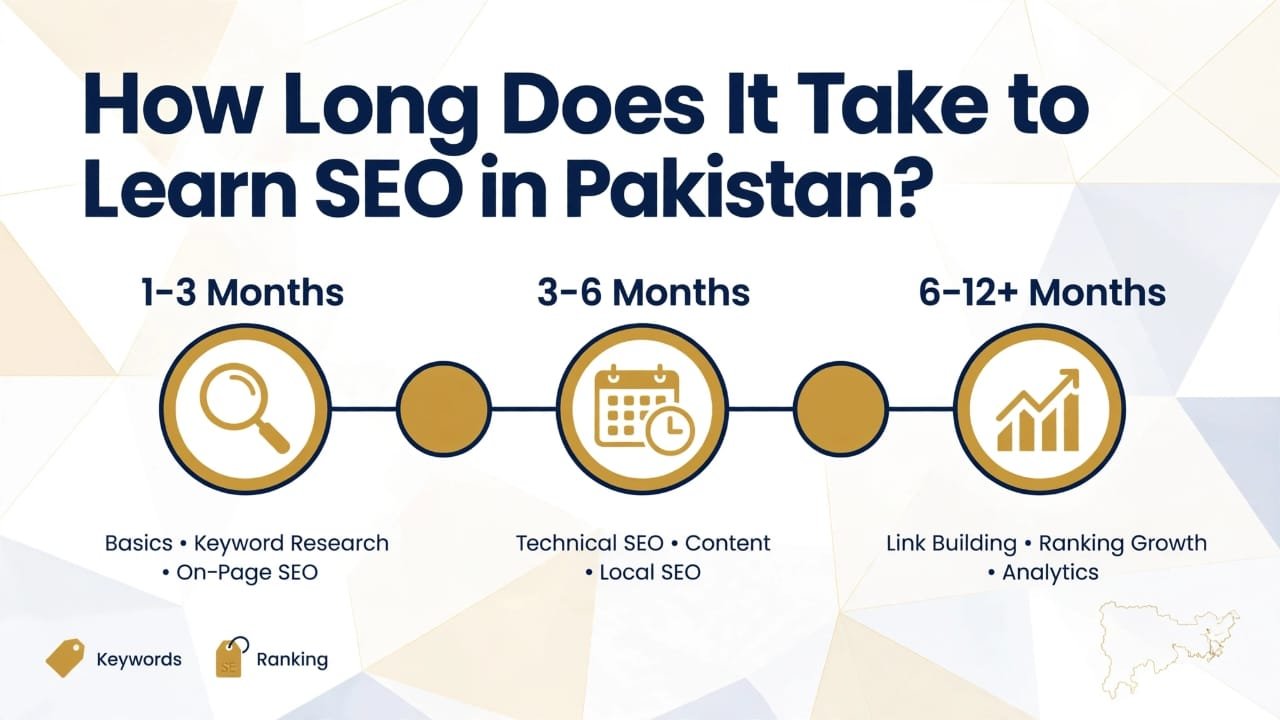
- Weeks 1–3: Fundamentals. How search engines crawl and index pages, on-page SEO (titles, headings, meta descriptions, internal linking), and basic keyword research. This part is mostly reading and understanding, not doing.
- Weeks 4–8: Hands-on practice. Working on an actual website — your own blog, a friend's business page, or a practice site. This is where on-page SEO, image optimisation and basic technical fixes start to feel natural instead of theoretical.
- Months 3–6: Content and off-page work. Writing content that is actually built to rank, understanding backlinks and why they matter, and getting comfortable with tools like Google Search Console, Google Analytics, and a keyword research tool.
- Months 6–12: Real judgement. By this stage, most people can run an SEO audit, build a basic strategy for a small business, and explain their reasoning. This is roughly the point where freelance SEO work or a junior SEO role becomes realistic.
These ranges assume a few hours of focused work most weeks. Someone studying SEO for 30 minutes once a week will obviously take longer; someone doing it daily alongside a real project will move faster.
Why most people get stuck
The biggest reason people feel like they are "not learning" SEO is that they stay in tutorial mode for too long. Watching videos about keyword research is not the same as doing keyword research on a real site with real competition. SEO only starts making sense once you are looking at your own data — your own impressions, your own click-through rate, your own rankings moving up or down — and trying to work out why.
A second common trap is chasing every new ranking "trick" instead of the fundamentals. Search engines change their algorithms often, but the basics — a fast, well-structured site, genuinely useful content, and a clean technical setup — have stayed important for years. Learn those properly first.
A third issue, especially for students working from home, is simply inconsistency. Load-shedding, unreliable internet, or a packed daily routine can turn "I'll study SEO this month" into a stop-start habit that takes three times as long. If this is a risk for you, it helps to study at a fixed time each day, even if it is only 20–30 minutes, rather than waiting for a free afternoon that never comes.
What actually speeds things up
A few things make a real difference to how fast someone learns SEO properly:
- Working on one real website from day one, instead of only following along with someone else's example.
- Checking Google Search Console weekly, even before you fully understand every metric — the habit of reading real data matters more than understanding every number immediately.
- Getting feedback on your work, whether from a mentor, a course instructor, or an online community, instead of guessing whether what you did was correct.
- Focusing on one niche or one site rather than trying to learn SEO for e-commerce, local business and blogs all at once.
A structured course with live instruction can shortcut a lot of the confusion that self-study creates, simply because you can ask a question the moment you get stuck instead of spending a week guessing. At MS Growth Academy, our SEO batches run live on Zoom, with practical work on real websites rather than theory alone, which is usually where the self-taught route takes people the longest to figure things out on their own.
Is SEO still worth learning in Pakistan right now?
Yes, in the sense that businesses — local and international — will always need their websites to be found. It is a skill that supports freelancing, in-house marketing roles, and agency work, and it pairs well with content writing, web development or digital marketing if you later want to broaden what you offer. It is not a skill where you flip a switch and start earning immediately; like any real skill, it rewards the people who stay consistent past the first confusing month.
The takeaway
Give yourself 6–8 weeks to understand the fundamentals properly, and 6–12 months of real, hands-on work before expecting to call yourself genuinely competent. Skip the shortcut videos promising instant rankings, work on one real site consistently, and check your data every week even when it is uncomfortable. That combination — structure, a real project, and patience — is what actually determines how long SEO takes to learn, far more than talent or luck does.