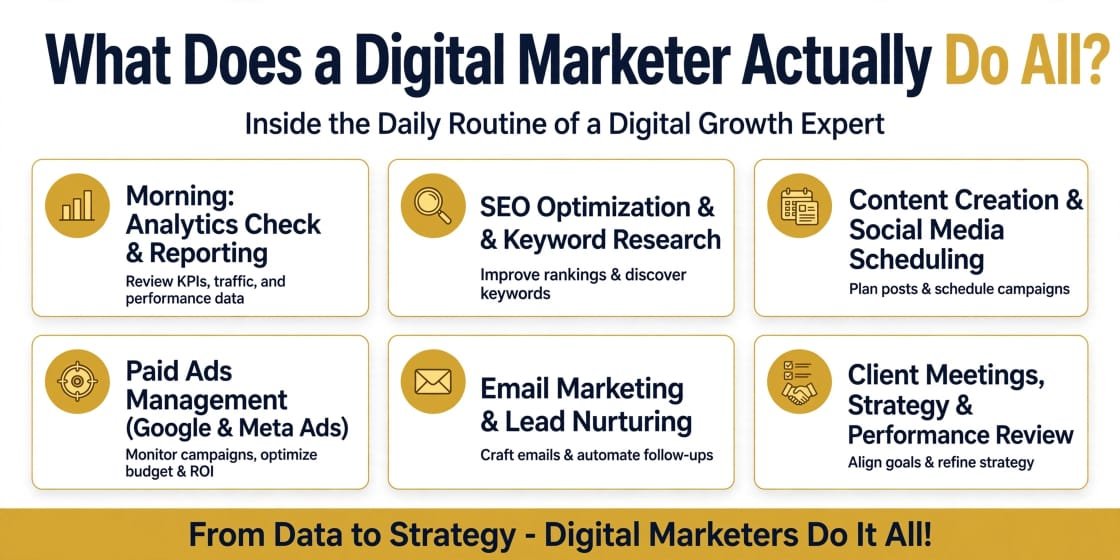
A digital marketer spends the day doing four things on repeat: checking what is working, creating or fixing content, running or adjusting paid ads, and reporting the numbers to someone who is paying for results. There is no single "typical day" because the mix changes with the size of the business, but almost every digital marketer's week is built from those same four blocks.
If you are thinking about this as a career or a freelance skill, it helps to see past the job title and into the actual tasks, because that is what you will be doing for eight hours a day — not a glamorous idea of "marketing".
The morning: checking what happened
Most digital marketers start the day by looking at numbers from the day before. This usually means:
- Checking ad performance in Facebook Ads Manager or Google Ads — which ads spent money, which ones got clicks or sales, which ones need to be paused
- Looking at website traffic in Google Analytics to see where visitors came from and what they did
- Checking social media insights — reach, comments, saves, follower growth
- Reading any messages or comments that came in overnight and need a reply
This is not optional busywork. A digital marketer who does not check the data every day is just guessing, and guessing with someone else's advertising budget is how accounts lose money fast.
The middle of the day: making and fixing things
Once the marketer knows what worked and what did not, the rest of the day goes into producing or adjusting things. Depending on the role, this could be:
- Writing captions, ad copy or blog content
- Briefing a designer for a graphic, or making a simple one themselves in Canva
- Setting up or editing a short-form video for Instagram Reels or TikTok
- Building or adjusting an email campaign in a tool like Mailchimp
- Updating a landing page based on what is converting and what is not
- Setting up a new ad campaign — choosing the audience, the budget, the images and the goal
A lot of this work is small and repetitive rather than creative in a big way. You might spend two hours getting one ad's targeting right, or an hour writing five versions of the same caption to test which one performs better. Patience with repetition matters more than people expect going in.
Meetings, client updates and reporting
Digital marketers also spend real time talking to people — a client, a manager, or a business owner who wants to know what their money bought. This usually means:
- A short call or message update on how campaigns are doing
- Preparing a simple report with screenshots or numbers from the ad platforms
- Explaining, in plain language, why something worked or did not — "the ad cost more this week because the audience was too broad" is a normal sentence to say several times a month
- Agreeing on the plan for the next week
If you freelance or work with multiple clients, this communication side can take up more of the day than the actual marketing work, especially early on when clients are still learning to trust your judgement.
What tools a digital marketer actually touches
The day-to-day toolkit is fairly consistent across jobs in Pakistan and abroad:
| Task | Common tool |
|---|---|
| Running ads | Facebook Ads Manager, Google Ads |
| Tracking website visitors | Google Analytics |
| Scheduling posts | Meta Business Suite, Buffer or similar |
| Email marketing | Mailchimp or similar |
| Simple graphics | Canva |
| Reporting | Google Sheets or Excel |
Nobody expects you to be an expert in all of these on day one. Most digital marketers learn two or three tools properly and pick up the rest as a job requires them.
How much of the day is "strategy" versus "doing"
New entrants often imagine digital marketing as mostly strategy — thinking big thoughts about brand positioning. In reality, strategy is maybe 10–15% of a working day. The rest is execution: writing the post, setting the budget, fixing the typo, replying to the comment, re-uploading the image that was the wrong size. The strategic thinking happens in short bursts, usually once a week when planning the next few days, and the daily grind is mostly hands-on work.
This is actually good news if you are starting out with no experience. You do not need to be a brilliant strategist to be useful. You need to be reliable, organised, comfortable with numbers, and willing to test things and adjust when they do not work.
Is this a desk job you can do from home?
Yes, almost entirely. Everything described above — checking data, writing content, running ads, reporting — can be done from a laptop with a stable internet connection. This is exactly why digital marketing is a popular skill to learn in Pakistan: it opens the door to remote jobs with local companies, freelance work with clients abroad, or simply running marketing for your own small business, all without needing an office. A dependable internet connection matters more than people expect, since load-shedding or a slow connection can cost you a client call or a missed ad deadline, so it is worth planning around that if you are freelancing.
What this means if you are deciding whether to learn it
Before committing time and money to learning digital marketing, be honest with yourself about two things: do you enjoy working with numbers and patterns, and can you handle doing small repetitive tasks well without getting bored? If both answers are yes, the skill itself is learnable in a structured way — strategy, ads, analytics and content each have clear fundamentals that do not require a special talent, just practice on real accounts.
That practical, hands-on side is also why this is better learned by doing than by reading alone. Courses that have you set up a real campaign with a real budget, rather than just watching slides, get you closer to what the job actually feels like day to day. At MS Growth Academy, the digital marketing classes run live on Zoom, so when your first ad campaign does something confusing, you can ask about it in that same session instead of waiting for an answer.
Start by picking one part of the toolkit — ads, analytics or content — and get genuinely comfortable with it before trying to cover everything at once. A digital marketer who is excellent at one thing is more useful than one who is vague about five.