What "laravel framework development" actually means
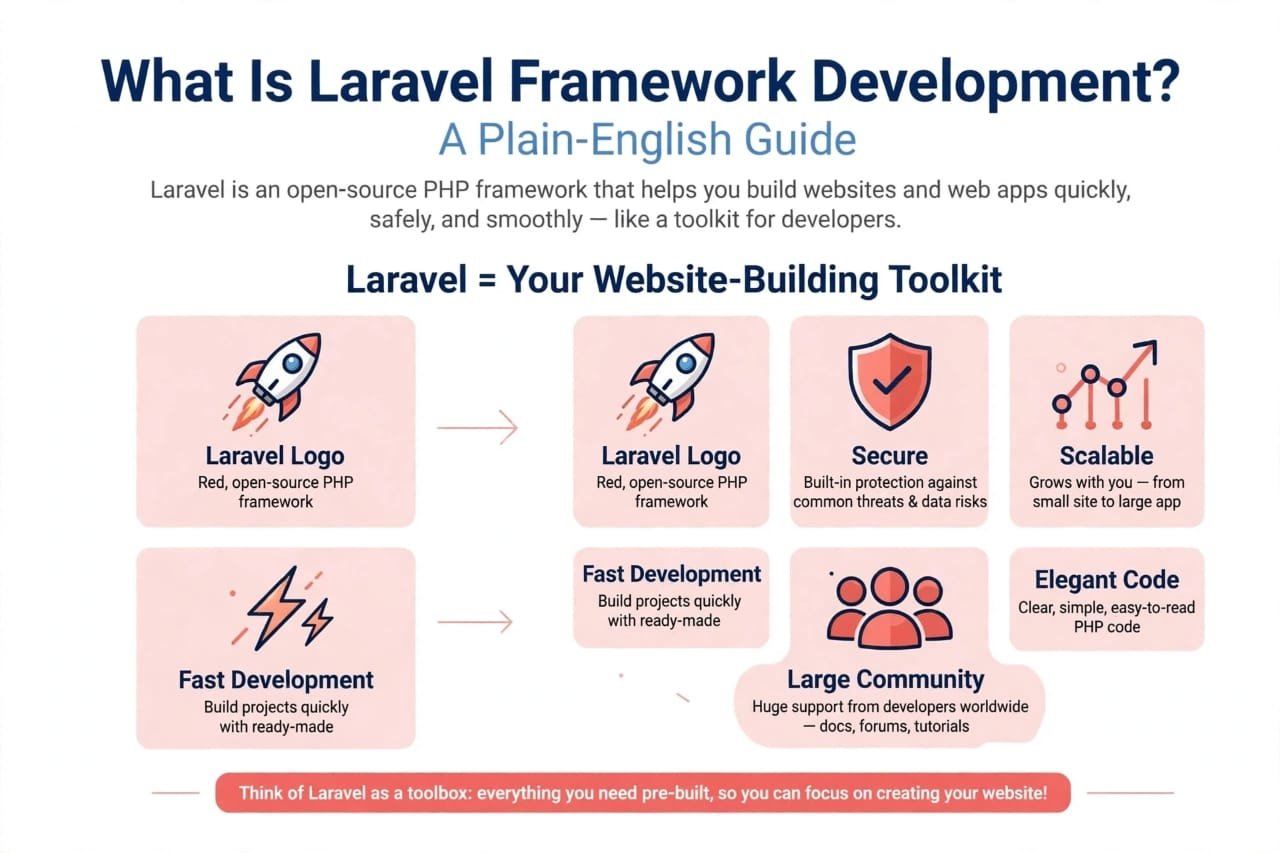
Laravel framework development means building a web application on top of Laravel's existing structure and tools, instead of writing every feature in plain PHP from scratch. Laravel is a PHP framework — a large, ready-made set of code for things almost every website needs: user accounts and login, saving and fetching data from a database, sending emails, handling forms safely, and organising files so a project does not turn into one giant, unmanageable script.
When a developer does "Laravel framework development," they are not coding raw PHP for every single feature. They are using Laravel's rules and ready-made building blocks, then writing the specific logic that makes that app different from any other Laravel app — the actual business, not the plumbing underneath it.
Why use a framework instead of plain PHP at all
Plain PHP gives you a blank page. You decide how files are organised, how the database is queried, how a user logs in, and how you stop someone typing malicious code into a form. Every one of those decisions is also a chance to get something wrong, especially for someone still learning.
A framework like Laravel removes most of those decisions. It gives you:
- A fixed way to organise files (so any Laravel developer can open your project and understand it)
- Eloquent, a tool that lets you work with database tables using normal PHP instead of writing raw SQL for everything
- Blade, a templating system for building pages without repeating the same HTML on every page
- Built-in protection against common attacks, so you are not responsible for remembering every security rule yourself
- Ready-made login, registration and password-reset screens you can generate in minutes, not days
- A command-line tool (Artisan) that creates files and runs routine tasks for you
This is the real difference between "PHP development" and "Laravel framework development." The first is the raw language. The second is the language plus a structure that has already solved the problems most projects run into.
What a Laravel framework development project actually looks like, step by step
A typical small Laravel project moves through the same stages:
- Routing – deciding which URL shows which page or runs which action.
- Controllers – the PHP classes that decide what should happen when a route is visited (fetch some data, save a form, show a page).
- Models and Eloquent – PHP classes that represent your database tables, so "find all orders from this customer" becomes a short, readable line of code instead of a block of SQL.
- Migrations – files that describe your database structure in code, so the whole team (or you, on a new computer) can rebuild the same database with one command.
- Blade views – the actual HTML pages the user sees, built from reusable pieces.
- Authentication – login, registration, and password reset, usually set up with Laravel's own starter kits rather than written by hand.
None of these steps are unique to one project. That is exactly the point of framework development — you learn the pattern once, and it repeats across almost every Laravel application you will ever build or maintain.
Laravel framework development vs plain PHP development
If you are deciding which one to focus on, the honest comparison looks like this:
- Speed – Laravel is faster to build with once you know it, because login, database work and page structure are mostly already solved.
- Learning curve – plain PHP is simpler to start, but you eventually rebuild the same features Laravel already gives you, just less safely.
- Job and client demand – in Pakistan's freelance and agency market, "Laravel developer" is searched and hired for far more often than "plain PHP developer," because most modern PHP projects are built on a framework.
- Maintenance – a Laravel project is usually easier for another developer to pick up later, because the structure is standard, not personal.
- What you still need to know – Laravel does not remove the need to understand PHP itself. You are still writing PHP; the framework just stops you from repeating the same groundwork on every project.
Is Laravel framework development hard to learn?
It depends on where you are starting from. If you already have solid PHP basics — variables, functions, arrays, how a database table works — picking up Laravel's structure usually takes a few weeks of consistent practice before you can build something real on your own. If you are starting from zero, it makes sense to spend time on core PHP first, so Laravel's shortcuts actually make sense to you instead of feeling like magic.
Either way, Laravel framework development is learned by building, not by reading. A student who builds three small projects — a simple blog, a to-do list with login, a basic admin panel — will understand the framework better than one who only watches tutorials for the same length of time.
A practical next step
If you are trying to decide whether to invest time in Laravel, the honest test is this: install it, follow one official tutorial fully, and see if the pattern of routes, controllers and views starts to feel familiar by the end. If it does, the rest is repetition and bigger projects. Structured, live classes help at this stage mainly because you can ask why something broke the moment it breaks, instead of guessing alone for an evening — which is how our Laravel batches on Zoom are set up, with a working project built alongside the class rather than watched from the sidelines.
Whichever way you learn it, treat Laravel as a tool for writing less repetitive code, not a shortcut around understanding PHP itself. Get the basics solid first, and the framework will make far more sense when you get there.