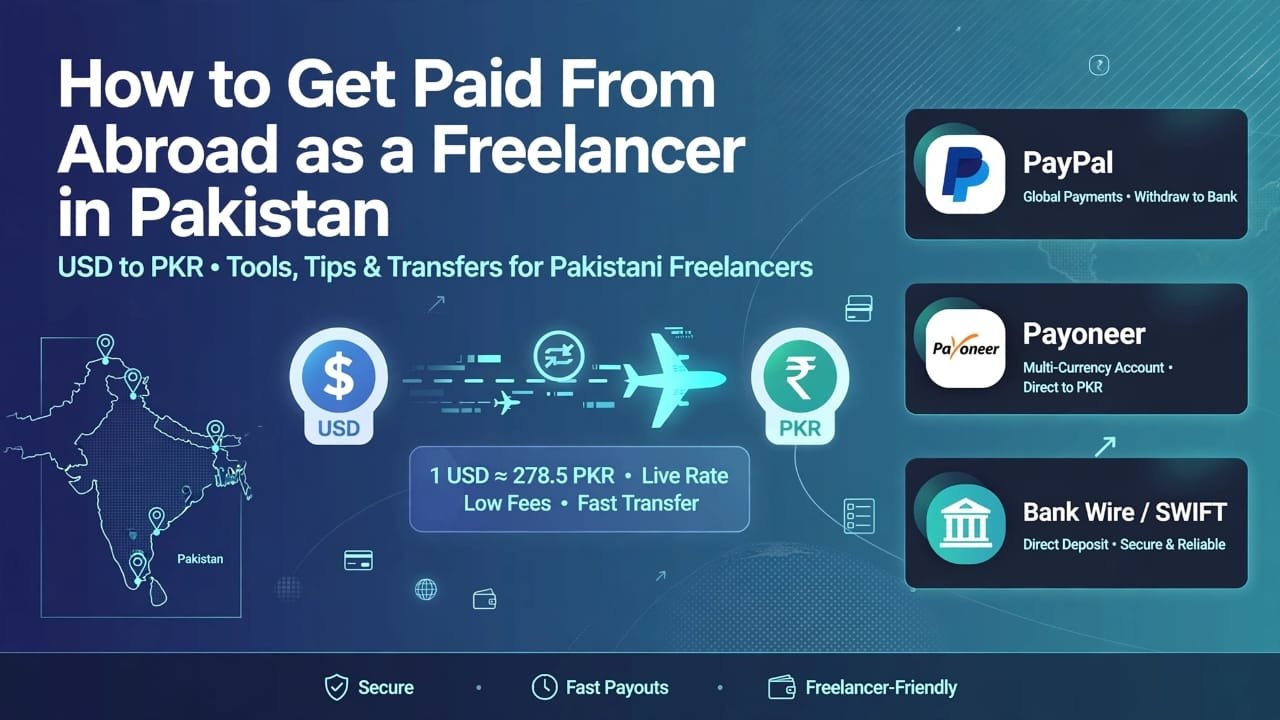
The three main ways to get paid from abroad as a freelancer in Pakistan are Payoneer, Wise, and a direct bank transfer (SWIFT) into your own Pakistani account. Most freelancers end up using Payoneer or Wise because they are built for exactly this job, charge lower fees than a bank wire, and connect directly to Fiverr, Upwork and most international clients. A direct bank transfer still works, but it is usually slower and costs more once you add up the charges on both ends.
If you are new to freelancing, this one decision — how the money actually reaches you — causes more confusion than almost anything else. Here is how each option really works, in plain terms.
Payoneer: the most common choice for Fiverr and Upwork
Payoneer is the payment method built into Fiverr and Upwork, so if you are working on either platform, you will likely open a Payoneer account anyway. You get a US bank account number (and sometimes UK and EU ones too) that clients or platforms can pay into, and the money sits in your Payoneer balance in dollars.
From there, you can:
- Withdraw to your Pakistani bank account in rupees, usually within one to three working days.
- Use the Payoneer card to spend directly or withdraw cash from an ATM.
- Keep the balance in dollars if you want to pay for things like a Fiverr gig boost, a course, or software.
Payoneer charges a small percentage when you withdraw to your local bank (commonly around 1–2%, though this changes, so always check the current rate in your account before withdrawing). There is no monthly fee just for holding an account. The exchange rate you get is close to the market rate but not identical to it — Payoneer keeps a small margin.
Wise: usually the cheaper option, but less common on marketplaces
Wise (formerly TransferWise) is not built into Fiverr or Upwork the way Payoneer is, so you will mostly use it when a client pays you directly — for example, a private client on a monthly retainer, or an agency sending your invoice payment. Wise gives you local account details in several currencies (USD, GBP, EUR), so a US client can send you a payment the same way they would pay any other US-based freelancer, with no international wire fee on their side.
Wise is generally known for:
- Lower conversion fees than a typical bank, often cheaper than Payoneer for the same amount.
- A transparent fee shown upfront before you confirm the transfer.
- Transfers to a Pakistani bank account that usually land within one to two working days.
The trade-off is that Wise is harder to connect directly to Fiverr or Upwork balances, so it suits freelancers with direct clients more than marketplace-only freelancers.
Direct bank transfer (SWIFT): slower and usually more expensive
Some clients, especially larger companies, will simply wire money straight to your Pakistani bank account using a SWIFT transfer. This works, and some banks in Pakistan have become more used to handling these from freelancers over the past few years. But there are two catches:
- Fees on both ends. The sending bank charges the client, correspondent banks along the way often take a cut, and your Pakistani bank may also charge a receiving fee. You can lose a noticeable chunk of a small payment this way.
- Paperwork. Your bank may ask what the payment is for, and for larger or more frequent amounts, you may need to show invoices or an explanation of your freelance work. This is normal and manageable, but it is an extra step Payoneer and Wise mostly avoid.
A SWIFT transfer makes more sense for larger, one-off payments than for small, regular freelance income.
JazzCash and Easypaisa: not for receiving money from abroad
JazzCash and Easypaisa are excellent for moving money inside Pakistan — paying for a course, sending money to family, topping up a wallet. But they are not set up to receive international freelance payments directly. The normal pattern is: get paid into Payoneer or Wise first, withdraw to your Pakistani bank account, then move money from your bank to JazzCash or Easypaisa if you need it there for daily spending.
A simple way to decide
If you are just starting out and plan to work mainly through Fiverr or Upwork, open a Payoneer account first — you will likely need it anyway, and it is the path of least friction. If you later start getting direct clients who invoice outside a marketplace, open a Wise account too, since it will usually save you money on those transfers. Keep a bank transfer as a backup for the occasional client who insists on it, not as your main method.
A few practical points worth knowing before your first payment:
- Both Payoneer and Wise ask for ID verification (your CNIC) before you can withdraw — do this when you open the account, not when you are waiting for your first payment to clear.
- Exchange rates move daily. If a payment is large, it is worth checking the rate on the day rather than assuming it will match what you saw last week.
- Keep a simple record of what you were paid and when, in rupees, after conversion. It makes tax season and any future loan or visa paperwork much easier, and it is a habit worth building from your very first payment, not your fiftieth.
- Withdrawal times can slip around public holidays on either end, so do not assume money will land on a specific day if you need it urgently.
The real first step
Before any of this matters, you need a client to pay you in the first place. If you are still at that stage, the payment method is the easy part — getting comfortable with your skill, building a small portfolio, and writing proposals that actually get replies matters more right now. Once that first payment is on its way, Payoneer or Wise will get it into your hands without much drama.
If you are learning a freelancing skill from scratch, our batches at MS Growth Academy run live on Zoom, so you can ask a practical question — including things like this — the moment it comes up, instead of guessing your way through it alone.