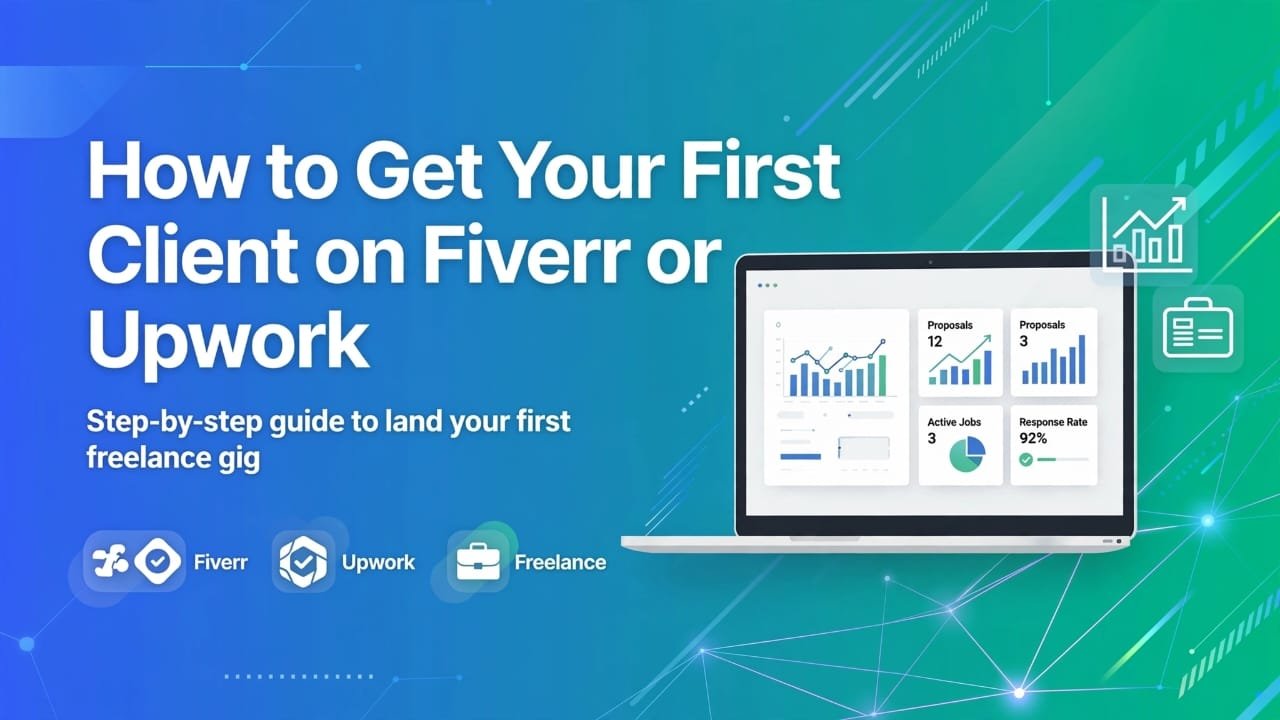
Your first client on Fiverr or Upwork almost never comes from luck. It comes from a narrow profile, a fair starting price, and a handful of proposals sent the right way, every single day, until one person says yes. There is no trick that skips this stage — but there is a sensible order to do it in, and most beginners skip straight to the wrong step.
Why the first client feels impossible
Both platforms rank sellers partly on history they do not have yet: reviews, completed orders, response time. A brand-new profile with zero reviews looks the same to a buyer as an empty shop. That is not personal, and it is not a sign you picked the wrong skill. It is simply the stage every freelancer passes through, including the ones now earning a steady income from abroad. The goal in week one is not to earn well. It is to get one real review from one real client, because that single review changes how the next ten buyers see you.
Step 1: Stop offering "everything"
New freelancers often list five or six services to look more hireable — logo design, social media posts, video editing, all on one profile. Buyers read this as inexperience, not range. Pick the one skill you can actually defend in a client call tomorrow, and say it in plain words. "I design Instagram carousel posts for small businesses" will get far more replies than "I do graphic design."
Step 2: Build a profile that answers the buyer's real question
A buyer scanning Fiverr or Upwork is really asking one thing: can this person deliver what I need without me having to manage them? Your profile should answer that in seconds.
- Use a clear photo of your face, not a logo — it builds basic trust faster than any paragraph can.
- Write your title and first two lines around the client's problem, not your own ambition ("I will design your shop logo in 48 hours," not "passionate creative professional").
- Show three to five samples, even unpaid practice work, clearly labelled as practice if it is.
- List your available hours honestly, including when you are offline for classes, Zoom sessions, or family commitments.
- Mention Payoneer or your bank details only when the platform asks for them during setup — never share them with a buyer directly.
Step 3: Price low enough to be chosen, not low enough to be exploited
For your first two or three orders, price slightly below the typical rate for your category rather than at it. On Fiverr this might mean a basic package priced around $5 to $15 depending on the skill; on Upwork it might mean a lower hourly rate for the first few contracts. This is not about undervaluing yourself forever — it is a short, deliberate phase to collect reviews quickly. Once you have four or five genuine five-star reviews, raise your price. Clients who hire at that stage are judging you on proof, not on being the cheapest option in the list.
Do not go so low that the work becomes a loss once you account for your time and internet costs. A fair starting price, paid honestly through Payoneer, JazzCash, or Easypaisa once it reaches your bank, is still a fair price even if it looks small in dollars.
Step 4: Go where the buyers already are
On Fiverr, your gig has to be found, so the title and the first line of your description need the exact words a buyer would type — "logo design for small business," not vague phrases. On Upwork, buyers post jobs and you apply, so the real work happens in your proposal, not your profile. Set aside thirty to forty-five minutes a day, every day, to send five to ten proposals or refresh your Fiverr gig tags. Consistency beats a single burst of effort.
Step 5: Write a proposal that actually gets read
Most beginner proposals get ignored because they talk about the freelancer, not the job. A proposal that gets a reply usually does three things in the first two lines: names the client's actual problem, shows you read their brief properly, and gives one concrete idea specific to their project. Save the generic introduction for the end, if at all.
For example, instead of "Hi, I am a hardworking designer looking for opportunities," try: "I noticed your shop logo needs to work in both English and Urdu script — here is a quick idea for how I'd balance the two." That single sentence proves you read the brief, which most applicants did not.
After you land the first order
Deliver slightly more care than the price suggests, but do not overdeliver so much that you cannot repeat it profitably. Communicate clearly and on time, even if that means saying "I am a student, so I reply mainly in the evening" upfront. Ask for the review politely once the client has approved the work — most buyers are happy to leave one if asked directly and professionally.
A few realistic points worth keeping in mind:
- The first client usually takes longer to find than the second or third — expect days or weeks of proposals before one lands, not hours.
- Your rate in the first month will likely be low. That is normal, not a sign of failure.
- A slow but reliable internet connection matters more than a fast one that keeps dropping during a client call — plan your work hours around your most stable connection window.
- Family members asking why you are not taking a "proper job" is common early on. A completed order and a real payment, even a small one, usually says more than an explanation does.
A practical takeaway
Treat your first client as a short, deliberate project with one goal: proof, not profit. Narrow your offer to one skill, price it to be chosen, send proposals daily, and ask for the review once the work is done. Everything after that — better rates, repeat clients, a steadier income — builds on that first review, not on finding a shortcut around it. If you are still building the underlying skill itself, our batches run live on Zoom, so you can ask a specific question the moment your own gig or proposal gets stuck.