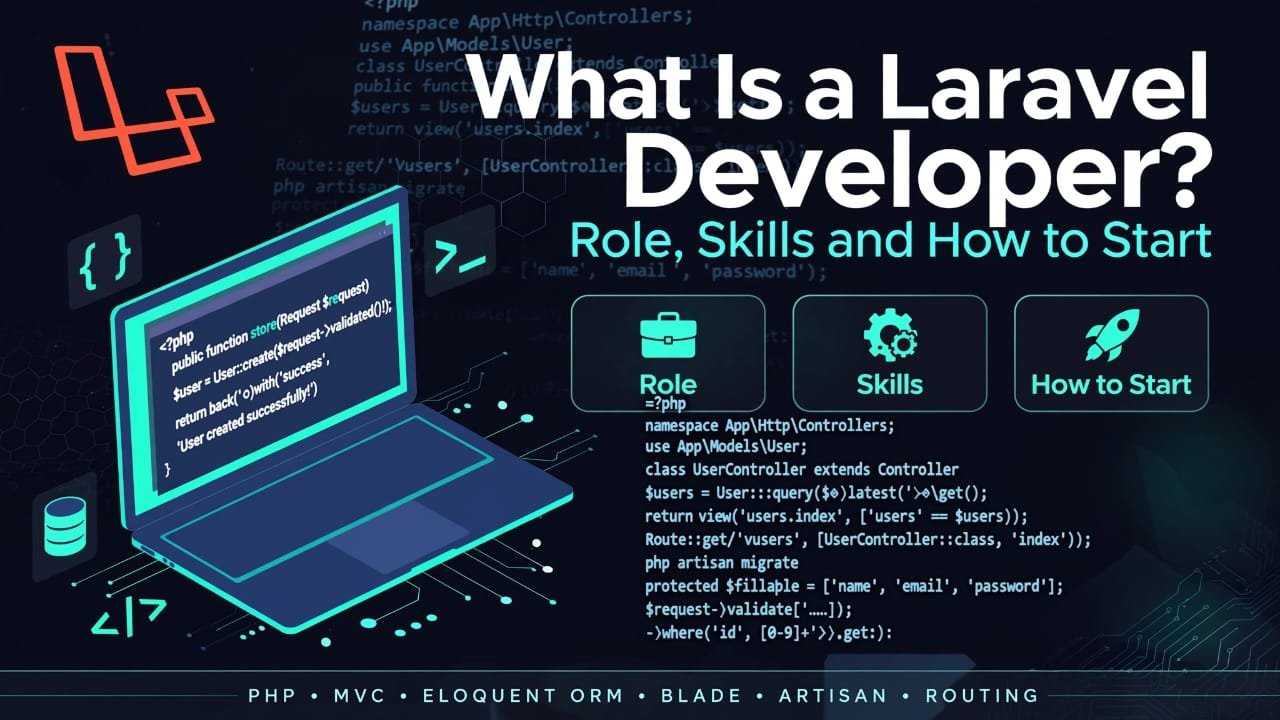
A Laravel developer is a web developer who builds websites and web applications using Laravel, a popular PHP framework. In plain terms: a Laravel developer writes the behind-the-scenes code that makes a website actually work — the part that saves a customer's order, checks a login, sends an email, or pulls products from a database — rather than just the part you see on screen.
What a Laravel developer actually does
If you have ever used a website to book a ticket, log into an account, or buy something online, there was a developer behind it building the logic that made it function. A Laravel developer's day-to-day work usually includes:
- Building the server-side logic for a website or web app (what happens after you click "submit")
- Designing and connecting the database that stores users, products, orders or bookings
- Setting up user authentication — login, signup, password reset
- Building admin panels so a business owner can manage their own content
- Connecting the site to other services, such as payment gateways or SMS/email providers
- Fixing bugs and keeping an existing Laravel application running smoothly
This is different from front-end work, which is about how a page looks and feels in the browser (HTML, CSS, and JavaScript). A Laravel developer can be purely back-end, or "full-stack" if they also handle the front end — many freelancers in Pakistan end up full-stack simply because clients want one person who can do the whole job.
Why Laravel specifically, and not just "PHP"
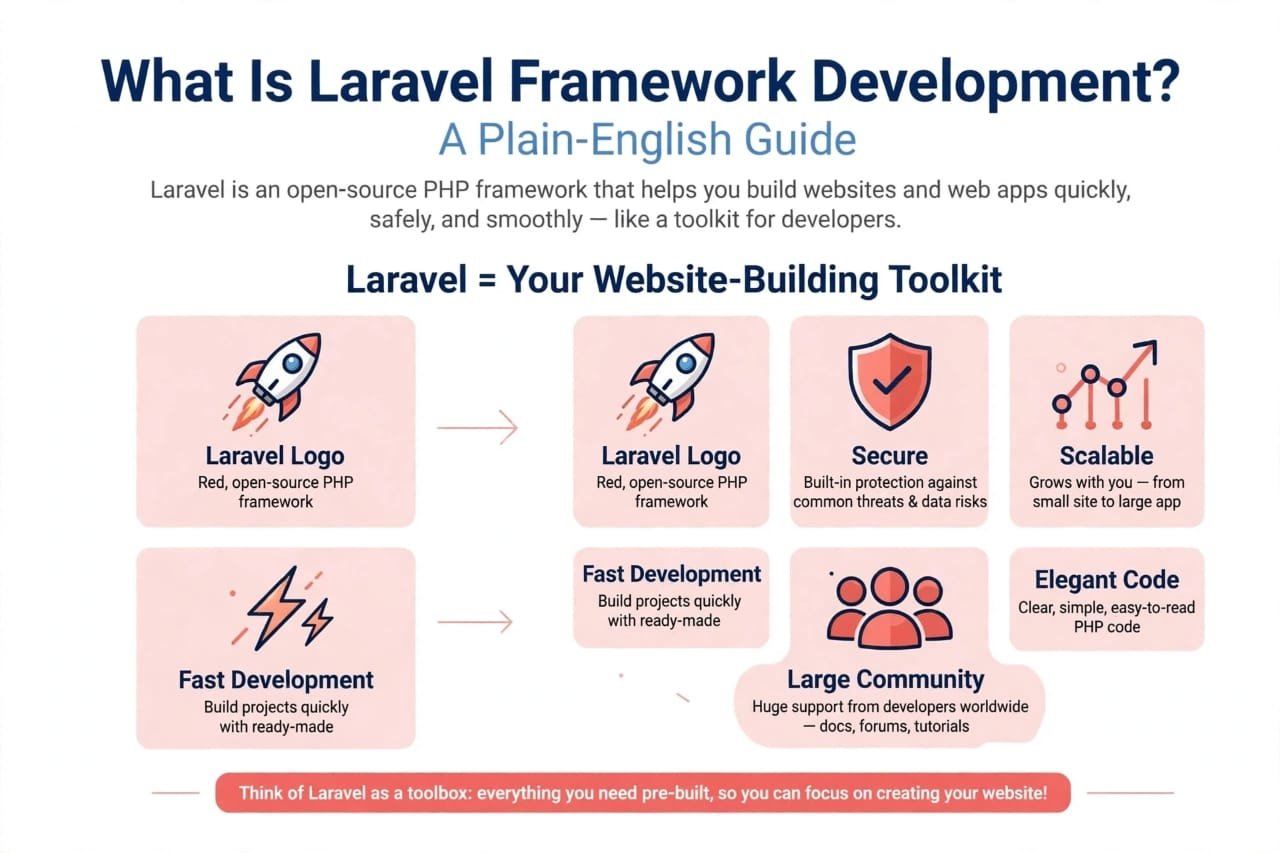
PHP is the language. Laravel is a framework written in PHP — a large set of ready-made tools that handle the repetitive parts of building a website, so a developer is not writing the same login system or database query from scratch on every project. This is why so many web development jobs and freelance gigs ask for Laravel by name rather than plain PHP: it is faster to build with, easier to maintain, and widely used by agencies and startups alike. If you search job boards or Upwork for PHP work, a large share of it is really Laravel work.
The skills a Laravel developer needs
You cannot skip straight to Laravel without the basics underneath it. A realistic skill list, roughly in the order you would learn it, looks like this:
- Core PHP — variables, functions, loops, arrays, and how a web request actually works
- MySQL — writing queries, designing tables, and understanding relationships between them
- HTML and CSS — enough to build and style basic pages, even if you plan to specialise in the back end
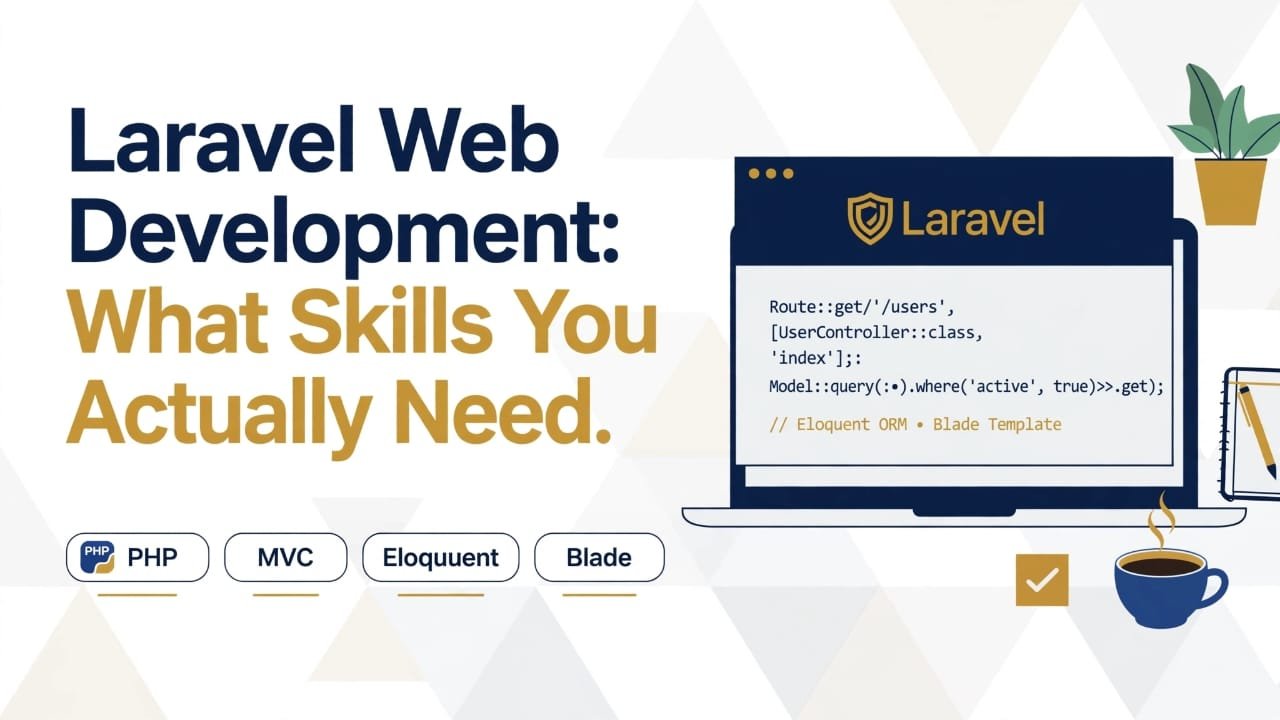
- Laravel itself — routing, controllers, Eloquent (Laravel's way of talking to the database), Blade templates, and authentication
- Git — version control, used on every real project and every real job
- Basic deployment — getting a finished project onto a live server rather than leaving it on your own computer
Each of these builds on the one before it. Trying to learn Laravel before you understand core PHP is one of the most common reasons beginners get stuck — the framework hides a lot of detail, and that detail catches up with you the moment something breaks.
How long it takes to become job-ready
This varies by how much time you can give it, but for someone studying with structure and building real projects rather than just watching videos, a sensible range is three to six months to reach a genuinely employable or freelance-ready level — not mastery, but enough to build a working application and reasonably defend your code in an interview or to a client. People who only watch tutorials without typing the code themselves tend to take much longer, because Laravel is learned by debugging your own mistakes, not by watching someone else fix theirs.
Along the way, build things you can show rather than only things you were told to build. A small booking system, a simple e-commerce backend, or an admin panel for a local business are all believable beginner projects that give you something real to point to, instead of a certificate alone.
What it can lead to
Laravel developers in Pakistan generally work in one of three ways: a full-time job at a local or international software house, remote work for a foreign company, or freelancing on platforms like Upwork and Fiverr. Freelance rates vary enormously depending on experience and the client's budget, so it is honest to say there is a wide range rather than a fixed figure — a beginner's early projects will earn far less than a developer with two or three years of real client work behind them. What matters more at the start is finishing real projects and getting them in front of real users, because that is what moves you from the beginner range to the next one.
One practical note for anyone studying from home with patchy internet or load-shedding: Laravel development does not need a constant connection once you are coding — only when you are looking things up, pushing to Git, or deploying. Plan your study sessions around that, and it stops being a major obstacle.
Where to start
If you are completely new, do not try to jump into Laravel tutorials on YouTube without a plan — it is easy to end up copying code without understanding the "why," and that falls apart the moment a client asks for a small change. A structured path — PHP basics, then databases, then Laravel, with projects at every stage and someone to ask when you get stuck — gets you there with far less wasted time. Our Laravel Development course runs live on Zoom in exactly that order, so you can ask a question the moment your code breaks rather than searching forums for an hour.
Start with the fundamentals, build something small and real as early as possible, and let the framework make sense once the basics are already solid.